

How to Create an Enriched Indoor Environment That Honors Your Cat's Natural Instincts
Your rescue cat spent time in a shelter environment—often with limited space, unfamiliar smells, and unpredictable routines. Now that they're home with you, creating an environment that reduces stress while satisfying their natural instincts isn't just nice to have. It's essential for their physical and emotional wellbeing.
The good news: you don't need a mansion to give your cat a rich, stimulating life. Two design principles are transforming how cat owners think about feline-friendly homes: maximizing vertical space and providing safe outdoor access through catios. Both approaches tap into your cat's evolutionary hardwiring while keeping them safe from the very real dangers of outdoor life.
This guide will walk you through the science behind why these design elements matter, practical options for every budget and living situation, and specific considerations for rescue cats who may need extra support during the transition to their new home.
The Indoor-Outdoor Debate: Why It Matters for Rescue Cats
Before diving into design specifics, let's address the elephant in the room: should cats go outside at all?
The statistics are stark. According to research from UC Davis, indoor cats live an average of 12-17 years, while outdoor cats average just 2-5 years. The difference isn't subtle—it's dramatic. Outdoor cats face traffic accidents, predators (coyotes, hawks, and even other cats), infectious diseases like FIV and feline leukemia, parasites, and exposure to toxins.
For rescue cats specifically, there's another consideration: many have unknown histories. A cat surrendered to a shelter may have been indoor-only their entire life, or they may have been a stray who survived outdoors for years. Either way, the transition period after adoption isn't the time to experiment with free-roaming access. During those crucial first weeks—what we call the 3-3-3 adjustment period—your cat needs safety and predictability, not the overwhelming stimulation (and danger) of unrestricted outdoor access.
But here's where it gets interesting: keeping cats indoors doesn't mean condemning them to a boring, unstimulating life. Research consistently shows that environmental enrichment—including vertical space and safe outdoor exposure—dramatically improves quality of life for indoor cats.
The Wildlife Factor
There's another compelling reason to keep cats contained: wildlife protection. A landmark study published in Nature Communications estimated that free-ranging domestic cats kill 1.3-4 billion birds and 6.3-22.3 billion mammals annually in the United States alone. Cats are skilled predators—it's one of the things we love about them—but that hunting instinct has significant ecological consequences when multiplied across tens of millions of outdoor cats.
Catios and vertical indoor spaces allow cats to engage their predatory instincts (watching, stalking, pouncing on toys) without the wildlife toll. Your cat gets to be a cat; native birds and small mammals get to live. Everyone wins.
Why Vertical Space Transforms Your Cat's World
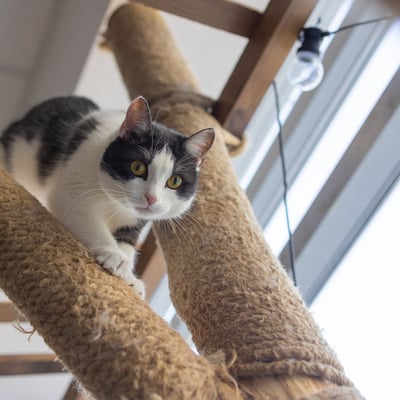
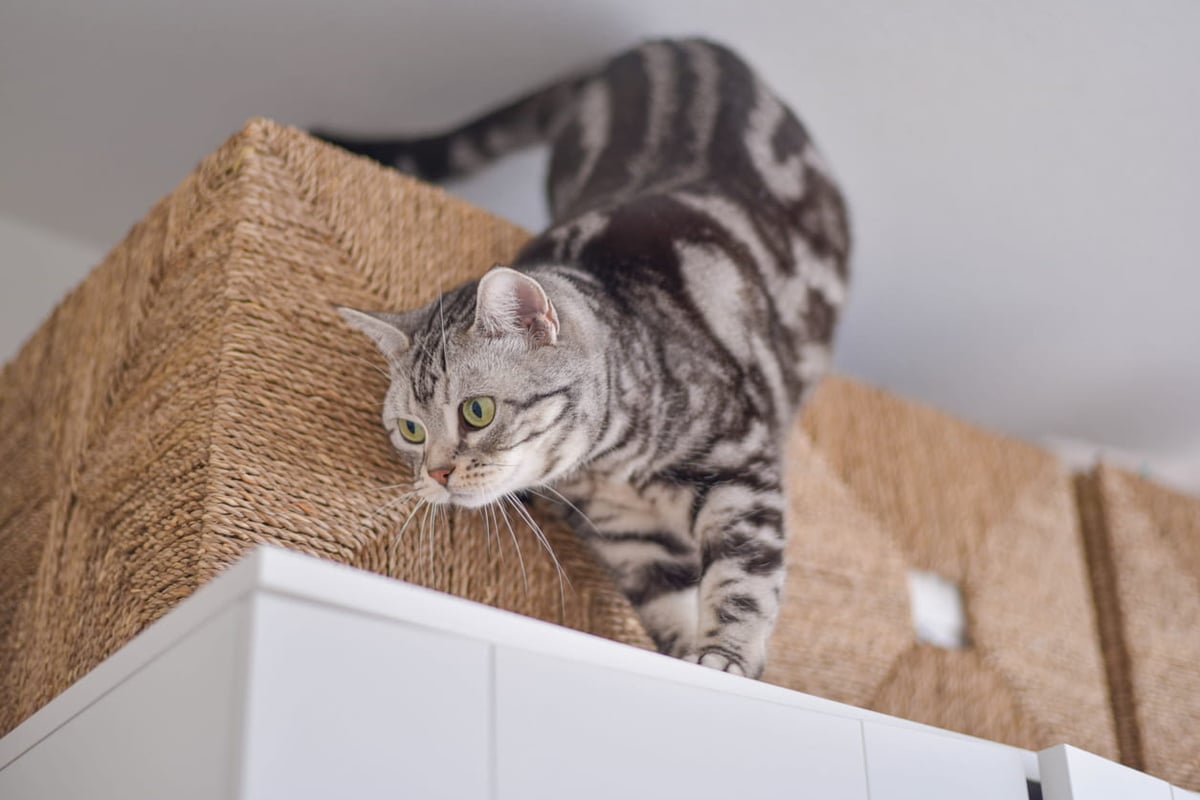
Walk into most homes with cats, and you'll see floor-level resources: food bowls, litter boxes, maybe a cat bed. But cats don't experience the world at floor level—they're hardwired to seek height.
The Evolutionary Explanation
Domestic cats are descended from Felis silvestris lybica, the African wildcat, a species that climbed trees to escape predators, survey hunting grounds, and rest safely above ground-level threats. Your rescue cat carries those same instincts. When they jump onto your refrigerator or perch on top of the bookshelf, they're not being difficult—they're following millions of years of evolutionary programming.
Height provides cats with:
- Security: An elevated position allows cats to observe potential threats while remaining out of reach
- Territory: Vertical space effectively expands your cat's territory without requiring more floor space
- Escape routes: In multi-pet households, elevated pathways give cats options for avoiding conflict
- Mental stimulation: Climbing and balancing engage problem-solving skills and physical coordination
What the Research Shows
This isn't just intuition—controlled studies back it up. A study published in Applied Animal Behaviour Science found that when cats were given access to vertical shelving, agonistic (aggressive) behaviors decreased significantly. The cats spent more time exploring and less time in defensive, low positions.
Another study in the Journal of Feline Medicine and Surgery found that providing vertical structures in shelter environments significantly reduced stress indicators in cats. Cats with access to elevated spaces showed fewer hiding behaviors, less aggression, and more willingness to interact with humans.
For rescue cats—who may already be dealing with the stress of a new environment—vertical space isn't a luxury. It's a tool for reducing anxiety and building confidence.
Vertical Space Options for Every Budget
Budget-Friendly ($0-100)
- Clear existing surfaces: Make the top of bookshelves, wardrobes, and cabinets accessible and cat-safe
- DIY shelf conversion: Basic wall-mounted shelves from hardware stores can be covered with carpet remnants or sisal rope
- Repurposed furniture: Tall bookshelves with some shelves cleared become instant cat climbing structures
- Window perches: Basic suction-cup mounted perches start around $20-40
Mid-Range ($100-500)
- Quality cat trees: Multi-level structures with scratching posts, platforms, and hideaways
- Wall-mounted shelf systems: Modular cat shelves designed specifically for feline use
- Cat bridges: Suspended walkways that connect elevated spaces across a room
- Window-mounted cat condos: Larger enclosed perches that attach to windows
Premium ($500+)
- Custom cat superhighways: Integrated wall systems with shelves, bridges, and climbing poles that circle entire rooms
- Floor-to-ceiling cat trees: Tall structures that maximize vertical territory
- Built-in cat furniture: Custom carpentry that integrates cat-friendly features into home design
Design Tips for Vertical Spaces
Create pathways, not dead ends. Cats feel safest when they have multiple routes to and from any location. A single cat tree in a corner is good; a series of shelves that connect the tree to other elevated spaces is better.
Consider traffic flow. In multi-cat households, narrow walkways can create conflict. Include "passing lanes"—wider platforms where two cats can be near each other without one blocking the other's path.
Provide variety. Include different surface textures (carpet, sisal, bare wood), different perch sizes, and both enclosed hiding spots and open platforms. Different cats prefer different resting styles.
Think about the view. Position perches near windows whenever possible. Watching outdoor activity—birds, squirrels, passing cars, pedestrians—provides hours of mental stimulation. This is especially valuable for cats who won't have catio access.
Ensure stability. Nothing destroys a cat's confidence faster than a wobbly perch. Wall-mounted shelves should be secured into studs, and freestanding structures should be heavy enough or anchored to prevent tipping.
The Catio Trend: Safe Outdoor Access
The catio—a portmanteau of "cat" and "patio"—has exploded in popularity over the past decade. The industry was valued at $325 million in 2024 and is projected to exceed $640 million by 2033. What was once a niche solution for anxious cat parents has become a mainstream feature of cat-friendly home design.
What Exactly Is a Catio?
A catio is an enclosed outdoor space that allows cats to experience fresh air, sunshine, natural sounds, and outdoor views—without the dangers of free-roaming. They range from simple window-mounted boxes to elaborate multi-room structures with tunnels, climbing features, and space for human seating.
The key defining feature: complete enclosure. A proper catio prevents cats from escaping while also keeping predators, other cats, and potential threats out. This typically means wire mesh or hardware cloth on all sides, including a roof.
Why Catios Work for Rescue Cats
For cats coming from shelter or rescue environments, catios offer several specific benefits:
Gradual outdoor exposure. A cat who's been indoor-only (or who spent significant time confined in a shelter) may be overwhelmed by sudden outdoor access. A catio provides a contained, controlled way to introduce outdoor stimulation without the risk of the cat bolting in panic.
Safe observation. Many rescue cats are cautious by nature—they've learned that unfamiliar situations can be dangerous. A catio lets them observe the outdoor world from safety, building confidence at their own pace.
Reduced escape risk. During the adjustment period, rescue cats may attempt to flee when startled. A catio provides outdoor enrichment without any risk of the cat escaping into an unfamiliar neighborhood.
Mental stimulation without danger. Outdoor sights, sounds, and smells provide far more stimulation than even the best indoor environment. For cats who may have behavioral issues rooted in boredom or under-stimulation, that enrichment can be transformative—without the risks of traffic, predators, or disease.
Types of Catios
Window Box Catios
The simplest option: a small enclosed structure that attaches to a window opening. The cat accesses the catio through the open window (often with a cat door insert for temperature control). Window boxes typically provide enough room for one or two cats to lounge and observe.
Best for: Apartments, renters (with landlord approval), limited budgets, single-cat households
Typical cost: $100-500 DIY; $300-1,000 pre-fabricated
Balcony Catios
For apartment dwellers with balconies, enclosing the entire balcony with cat-safe mesh creates a larger outdoor space. This typically involves attaching netting or wire mesh to existing railings and adding a mesh ceiling.
Best for: Apartment balconies, patios, porches
Typical cost: $200-800 DIY; $500-2,000 professional installation
Freestanding Catios
Portable, pre-fabricated structures that don't attach to the home. These are placed in yards, on patios, or on decks and connected to the house via a cat door or tunnel system. Some are designed to be moved as needed.
Best for: Renters, homeowners who want flexibility, those testing the concept before investing in permanent structures
Typical cost: $200-1,500 depending on size
Attached Catios
Permanent structures built against an exterior wall, typically accessed through a cat door installed in a window, door, or wall. These can range from simple lean-to designs to elaborate multi-level enclosures.
Best for: Homeowners, multi-cat households, those wanting maximum space
Typical cost: $500-2,000 DIY; $2,000-10,000+ custom-built
Walk-In Catios
Larger structures with enough space for humans to enter, sit, and spend time with their cats. These often include seating, plant beds, and elaborate climbing features.
Best for: Dedicated cat enthusiasts, those with yard space, multi-cat households
Typical cost: $3,000-15,000+ custom-built
Essential Catio Features
Regardless of size or type, every catio should include:
- Escape-proof construction: Use hardware cloth (welded wire mesh) rather than chicken wire, which cats can squeeze through or tear. Ensure all seams and edges are secure.
- Weather protection: Include a solid roof section or shade cloth to protect from rain and intense sun. Polycarbonate panels work well for rain protection while allowing light.
- Multiple levels: Vertical space matters in catios too. Include shelves, perches, and climbing features at various heights.
- Hiding spots: Enclosed cubbies or houses give cats a retreat when they feel overwhelmed.
- Scratching surfaces: Sisal-wrapped posts or natural wood logs provide scratching opportunities.
- Fresh water: Cats spending time outdoors need access to clean water, especially in warm weather.
Catio Safety Considerations
Plants: Many common plants are toxic to cats. If adding greenery to your catio, research every plant carefully. Safe options include cat grass, catnip, catmint, and spider plants. Avoid lilies (highly toxic), azaleas, and many common garden plants.
Predators: Even enclosed, a catio can stress cats if they feel threatened. In areas with coyotes, hawks, or aggressive stray cats, ensure the mesh is sturdy enough to prevent break-ins and consider adding solid panels at lower levels to block line of sight.
Temperature: Catios can get dangerously hot in summer or cold in winter. Provide shade, ventilation, and consider adding a heated pad for cold weather. Never leave cats in a catio during extreme temperatures without supervision.
Exit strategy: Ensure cats can always return indoors. Cat doors should be reliable and easy to use. Consider a backup method of access in case the primary door fails.
Solutions for Small Spaces and Apartments
Living in an apartment doesn't mean your rescue cat can't have vertical space and outdoor exposure. It just requires more creativity.
Maximizing Vertical Space in Small Homes
Go up, not out. When floor space is limited, walls become prime real estate. Wall-mounted shelves, cat ladders, and ceiling-mounted perches take advantage of space that would otherwise go unused. A "cat superhighway" running along the upper walls of a studio apartment can provide more climbing territory than a large cat tree in a house.
Multi-functional furniture. Look for human furniture that doubles as cat furniture. Some modern designs include coffee tables with built-in cat beds, bookshelves with integrated climbing features, and TV stands with cat tunnels.
Door-mounted options. Over-door cat perches and hanging beds don't take up any floor or wall space. They're also portable—important for renters who may move.
Tension-mounted cat trees. Floor-to-ceiling cat poles that secure with tension (no drilling required) work well in apartments and can be removed without damaging walls or ceilings.
Apartment Catio Options
Window catios: If you have a window that opens outward, a window box catio may be possible even in an apartment. Always get landlord approval and ensure the installation is secure.
Balcony enclosure: Enclosing a balcony with cat-safe netting is often possible in apartments. Some netting systems are designed to be installed without permanent modifications—important for renters.
Portable pop-up catios: Collapsible mesh enclosures can be set up on balconies or patios when you're home to supervise, then stored when not in use. Not a permanent solution, but an option for supervised outdoor time.
A Note for Renters
Always discuss plans with your landlord before installing anything. Many landlords are receptive to cat enrichment features, especially when you explain the benefits (happier cat = less scratching on walls and carpets). Offer to restore the space to its original condition when you move, and document the pre-installation state with photos.
For permanent installations like wall-mounted shelves, some landlords will agree if you use professional-grade mounting and repair any holes when you leave. Others may prefer you stick to freestanding and temporary options. Know your lease terms and communicate openly.
Special Considerations for Rescue Cats
While all cats benefit from vertical space and environmental enrichment, rescue cats may need a more gradual introduction.
During the Adjustment Period
When you first bring your rescue cat home, overwhelming them with too much space or stimulation can backfire. Start with a single "base camp" room that includes basic vertical options—a cat tree, a window perch, or a cleared shelf—but keep things simple.
If your cat came from a shelter environment with limited vertical access, they may not immediately understand that elevated spaces are for them. Place treats and familiar-scented bedding on perches to encourage exploration. Don't force it—let them discover vertical territory at their own pace.
For Fearful or Under-Socialized Cats
Vertical space is especially valuable for fearful cats because it provides escape routes and safe observation points. A cat who can retreat to a high shelf when overwhelmed is less likely to hide under a bed for days at a time.
For these cats, consider:
- Enclosed perches: Covered cat beds on elevated surfaces feel safer than open platforms
- Multiple escape routes: Ensure the cat can get up AND down without being cornered
- Gradual catio introduction: Start with short supervised sessions rather than unlimited access
- Window viewing before catio access: Let the cat watch the outdoors from inside for several weeks before introducing a catio
For Cats with Unknown Histories
If your rescue cat's history is unknown, you may not know whether they've ever had outdoor access or vertical space. Watch their behavior for clues:
- A cat who immediately seeks high ground likely had previous access and will benefit from robust vertical options
- A cat who seems confused by elevated spaces may need encouragement and time
- A cat who shows extreme fear of outdoor stimuli (birds, wind, outdoor sounds) should have very gradual catio introduction, if at all
As always, reading your cat's body language is essential. Watch for signs of stress (hiding, over-grooming, loss of appetite) and adjust accordingly.
DIY vs. Professional Installation
When DIY Makes Sense
- Simple wall-mounted shelves (if you're comfortable with finding studs and using a drill)
- Basic window box catios using pre-made components
- Balcony netting systems designed for DIY installation
- Freestanding or portable catios that require assembly but no construction
When to Hire a Professional
- Attached catios that require cutting into exterior walls
- Large or complex structures where structural integrity is critical
- Custom designs requiring carpentry skills
- Any installation where a mistake could allow cat escape
- Situations where landlord requires professional installation
Finding Catio Builders
The catio industry has grown enough that many areas now have specialized builders. Search for "catio builder [your city]" or "cat enclosure contractor." General carpenters can also build catios from DIY plans, which are available from various catio designers online.
When evaluating builders:
- Ask for references and photos of completed projects
- Ensure they understand escape-proofing requirements (many general contractors don't)
- Get written specifications for materials (wire gauge, wood treatment, hardware)
- Clarify warranty terms and what happens if there are issues
Designing for Multi-Cat Households
If you've adopted multiple cats—or you're adding a rescue cat to a home with existing cats—vertical space becomes even more critical.
Preventing Resource Guarding
Cats who feel they have limited territory may guard resources more aggressively. Vertical space effectively multiplies available territory, reducing the pressure that leads to conflict. A room with wall shelves, cat trees, and floor space gives each cat more "room" than the same physical space without vertical options.
Creating Multiple Pathways
In a single-cat household, a dead-end perch is fine—the cat can simply turn around. In a multi-cat household, dead ends create conflict when one cat blocks another's path. Design vertical spaces with multiple entry and exit points whenever possible.
Individual Resources
Each cat should have access to their own preferred vertical space without having to confront another cat. This might mean multiple cat trees in different rooms, or a wall system with enough platforms that there's always somewhere available.
Catio Considerations for Multiple Cats
Size matters more with multiple cats. Ensure the catio is large enough that cats can have space from each other. Include multiple levels and hiding spots so subordinate cats have retreat options. Watch for bullying behaviors—if one cat is monopolizing the catio or preventing others from entering, you may need to add a second entry point or schedule separate catio time.
Getting Started: A Step-by-Step Plan
Week 1-2: Assessment
- Observe your cat's current behavior. Where do they spend time? Do they seek height? Do they watch windows?
- Evaluate your space. What walls could accommodate shelves? Is there a window suitable for a catio? Do you have outdoor space?
- Set a realistic budget. Start with what you can afford now; you can always add more later.
- Check with your landlord if renting.
Week 3-4: Start Small
- Add one or two low-cost vertical options: a cleared shelf, a window perch, or a basic cat tree.
- Observe how your cat responds. Are they using the new spaces?
- Adjust placement if needed.
Month 2+: Expand Based on Success
- If your cat loves vertical space, add more. Connect isolated perches into pathways.
- Consider a catio if you have suitable outdoor space and your cat shows interest in outdoor viewing.
- Continue observing and adjusting. Your cat's preferences may change as they settle into their new home.
The Bottom Line
Creating a feline-first home doesn't require a complete renovation or an unlimited budget. It requires understanding what cats need—security, territory, mental stimulation, and safe ways to express natural behaviors—and making thoughtful changes that address those needs.
For rescue cats, environmental enrichment is especially meaningful. These cats have often experienced stress, uncertainty, and limited resources. A home that offers vertical territory to claim, safe outdoor views to watch, and climbing opportunities to explore sends a powerful message: this is your space, you're safe here, and your needs matter.
Whether you start with a $30 window perch or invest in a custom catio, every improvement makes your cat's world a little larger, a little more interesting, and a little more aligned with their natural instincts. And a fulfilled, enriched cat is a healthier, happier companion.
Your rescue cat took a chance on you. Return the favor by giving them an environment where they can truly thrive.
Additional Resources
- The 3-3-3 Rule for Pet Adjustment – Understanding your rescue pet's transition timeline
- Understanding Cat Body Language – Reading your cat's signals
- Multi-Pet Harmony – Managing multiple cats in one household
- City Apartment Pet Adoption Guide – Making small spaces work for pets
- Cat Leash Training – Another option for supervised outdoor access
- GPS Trackers for Pets – Extra peace of mind for outdoor access